


External building thermography with drones for energy, insulation and moisture indications
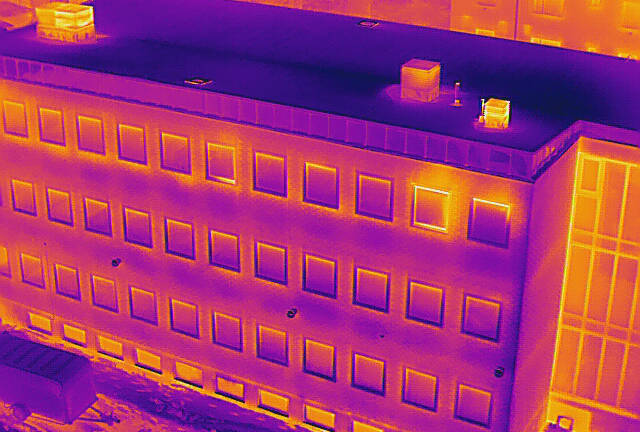
Energy leakage involves both economic and environmental costs. Gerdes Solutions has extensive experience with drone-based building thermography. The result of the thermography is data for evaluating insulation, warm air leakage and moisture ingress, helping property owners plan measures and reduce energy losses.
Get a quote
Describe the building, experienced problems, approximate size and whether you want to investigate energy leakage, insulation, moisture indications or the need for measures.
Common problems we help identify
If you experience problems with the indoor climate or high heating costs, external thermography with drones is an effective method for evaluating and locating the problem. When planning measures on the building envelope, the data we produce can be helpful for priorities and decisions.
If the assignment concerns a specific roof problem, thermographic inspection of flat roofs may be a more targeted service. For pipe networks, we also offer thermography of district heating networks.
Method: how the work is carried out
- Needs review: We jointly review your needs and expectations, as well as any limitations.
- Quote: We provide a cost proposal based on the execution agreed during the needs review.
- Preparations: We monitor the temperature and carry out site-specific flight preparations.
- Thermography: When temperature and other weather conditions are favourable, we carry out the thermography at night.
- Analysis: A certified ITC Level 2 thermographer analyses the collected image material.
- Delivery: You receive an inspection report with suspected leaks, the option to access all image/video material and a digital meeting to review the result.
Delivery:
- PDF report
- Review of the result in a digital meeting
- Option to access raw data
Why use drones?
With drones, we can quickly thermograph large areas from a camera angle that provides optimal conditions for identifying energy leakage. Aerial thermography makes it possible to inspect surfaces that are difficult to access with handheld thermography, such as surfaces above trees located close to the facade. It is also an advantage that the data collection has no impact on the building or ongoing operations.
Conditions and limitations
Thermography is carried out at night, when the conditions for identifying energy leakage are best. Temperature has a major impact on the result, and the greater the difference between indoor and outdoor temperature, the better. A temperature difference of at least 10 degrees C is needed.
Because different materials are suited to thermography to varying degrees, we review the choice of method and any limitations together with you before accepting the assignment.
Experience, permits and quality
To carry out building thermography safely and legally throughout Sweden, we hold generic authorisation in the specific category according to SORA for drone flights in populated areas.
To ensure reliable results, we mainly use drones with calibrated FLIR cameras, primarily A655sc. Data collection and analysis are carried out by a certified ITC Level 2 thermographer.
Frequently asked questions
Where should I add extra insulation?
Our thermography and subsequent analysis show where there are defects in the insulation. The result, combined with the property owner’s or manager’s knowledge of the building and its construction, provides answers about which surfaces are valuable to investigate further and address.
What does building thermography cost?
Prices vary depending on where the building is located and how large and complex it is. Contact us for a quote.
Can moisture damage be detected with building thermography?
Yes, moisture indications in facades and roofs can be identified using building thermography. If leakage in flat roofs is suspected, thermographic roof inspection may be a more specific setup.
When is the best time to thermograph a building?
The temperature difference between inside and outside has a major impact on the result. For that reason, it is best to carry out thermography during a cold night, mainly from September to April.
Is it faster to thermograph with a drone from the outside than from inside the building?
Yes, drone thermography is an efficient method that saves a great deal of time while the operations inside the building are not affected. In some cases, it can be valuable to complement aerial thermography with handheld thermography from the inside.
Free quote for thermography of buildings
Send a brief description of the building and what you want to investigate, and we will assess method, conditions and cost.