


For leak detection and network analysis
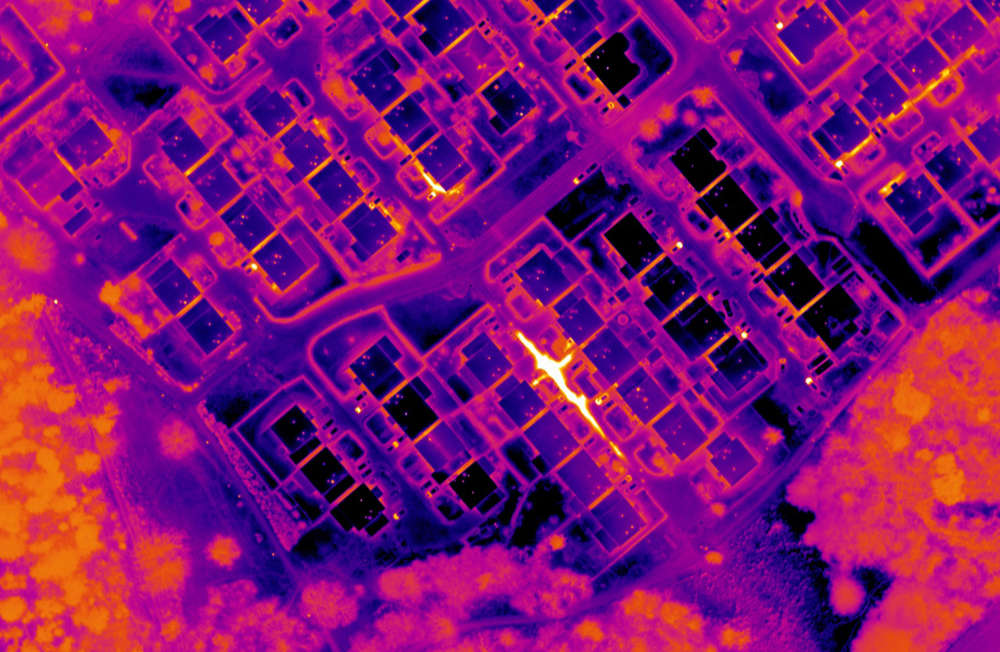
A leak in a district heating network can lead to major energy losses, ground subsidence and unwanted costs. By carrying out aerial thermography of the district heating network and measuring thermal radiation, we can quickly find small temperature deviations that reveal hidden leaks and insufficient insulation. The method results in a clear overview of the network’s condition, helping you plan measures and avoid operational disruptions.
Get a quote
Describe your district heating network, approximate pipe length and whether the need concerns planned inspection, an acute leak or quality control of a new network.
When is aerial thermography relevant?
When you know there are leaks in the district heating network, but cannot locate them with alarms or other methods, aerial thermography is an effective way to identify the problem.
Aerial thermography can also be planned as part of ongoing district heating network inspection. When thermography is repeated continuously, data can be compared from year to year and defects can be identified and addressed at an early stage.
When constructing new networks, drone-based aerial thermography can also be carried out during the construction phase. This helps ensure the quality of materials and installation.
For other thermographic assignments, we also offer thermography of buildings and thermographic inspection of flat roofs.
Method: how the work is carried out
- Request and quote: We receive your request and provide a cost proposal based on the area and the size of the network.
- Preparations: The schedule and communication are established. We monitor the weather and carry out site-specific flight preparations.
- Aerial thermography: We carry out the flight under the right weather conditions, at night, using a high-resolution thermal camera.
- Analysis: Termisk systemteknik analyses the thermal images.
- Delivery: You receive a detailed report with suspected leaks, map images and a review of the result in Termisk systemteknik’s proprietary software.
Why use drones?
With drones, we can quickly thermograph relatively long pipe sections, up to 35 km in one night.
The drone’s low flight altitude combined with an advanced FLIR camera provides a high level of detail, making it possible to detect small leaks at an early stage.
The method does not require road closures, excavation or other disruption to the surrounding area. Since the drones used are electric, the method also has a small climate footprint.
Conditions and limitations
Thermography is carried out at night, when solar radiation does not distort the result.
Temperature and ground conditions have a major impact on the final result. For that reason, thermography is mainly carried out from October to March and when the ground is free from snow and moisture.
For acute leaks in more limited areas, thermography may also be possible during other parts of the year. In those cases, flight altitude and speed are adapted to create the best possible result under the prevailing conditions. Whether the assignment is suitable is assessed case by case and in dialogue with the customer.
Experience, permits and quality
In close collaboration with Termisk systemteknik, a company specialised in thermal cameras and thermal camera technology, we have carried out drone-based aerial thermography of district heating networks for ten years. To ensure reliable results, drones with calibrated FLIR cameras are used, mainly A655sc.
To carry out thermography of district heating networks safely and legally throughout Sweden, we hold generic authorisation in the specific category according to SORA for drone flights in populated areas.
Thermography is carried out by a certified ITC Level 2 thermographer. The analysis is performed by Termisk systemteknik, which has also developed its own software where AI identifies patterns and temperature deviations with high precision as support for the analysis.
Frequently asked questions
What does aerial thermography cost?
Prices vary depending on the size of the network and the geography of the area. Contact us for a quote.
How accurate is leak detection with drones?
Aerial thermography with drones provides very high resolution and can identify even small temperature deviations that indicate leakage.
When is the best time for aerial thermography?
Flights are best carried out during cold, clear nights in autumn, winter or early spring, when heat leakage is most visible in the thermographic images.
How quickly do we receive the result from the flight?
Reports, map material and software are usually delivered within 1-2 weeks after the flight has been completed.
How large can a district heating network be for drone thermography?
Drone thermography can be carried out on all district heating networks, but it is most cost-effective on networks with up to 90 km of pipe. We usually thermograph 20-35 km of pipe per night.
Free quote for thermography of district heating networks
Send a brief description of the network size, area and purpose of the inspection, and we will get back to you with a recommended setup and quote.